

Please disable your AdBlocker, it helps keep Avian Directory free for all bird lovers to use.
Register an account or Log in. Logged in members do not see adverts!
Thank You
Identifying the gender of birds can sometimes be more of a challenge than you may expect, this page will try to help with gender identification.
All birds, including the Gouldian finch, are categorised into three distinct groups: Monomorphic, Dimorphic, and Polymorphic. You may or may not have heard of these terms before, but they are not as complicated as they sound. Some species can be both dimorphic and polymorphic. Each category is explained below.
The word Di means two or double, and Morphic (or morphism) refers to a specific form or shape. Together, dimorphic means two distinct forms within the same species.
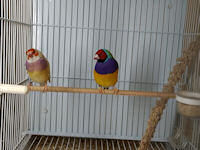
In practical terms, this means there is a visible difference between the male and female of the same species. For example, male Gouldian finches have brighter and more vibrant colours, whereas females tend to have duller tones. When a male and female are placed side by side, this difference in colour intensity becomes obvious.
Because of this clear visual distinction, the Gouldian finch is considered a dimorphic species. It also fits into another category, polymorphic, which is explained below.
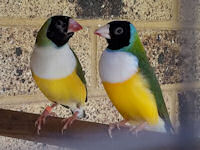
The prefix Mono means single or one, and Morphic refers to form or shape. Together, monomorphic means a single form within a species.
In monomorphic species, males and females look almost identical. There are little to no visible differences in colour, markings, size, or weight that can be used to identify sex. Because of this, males and females cannot be reliably distinguished by appearance alone.
Gouldian finches are not monomorphic.
You may associate the word mono with monochrome, which is understandable. However, Gouldian finches occur in three head colours: red, orange (genetically yellow), and black. If every Gouldian had identical colours, patterns, and shading, and their offspring were the same generation after generation, they would be considered colour-monomorphic — but this is not the case.
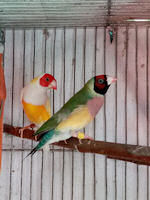
The prefix Poly means many or more than one. Combined with Morphic, polymorphic refers to two or more recurring forms within a single species.
Using the Gouldian finch as an example, the species displays three genetically recurring head colours: black, red, and orange (genetically yellow). These traits are inherited and continue to reappear throughout the population.
Although Gouldian finches are genetically one species, the presence of multiple stable colour traits within the population makes them colour polymorphic.
Out of approximately 10,000 bird species worldwide, only around 300 are considered polymorphic.
A non-polymorphic example would be the robin. Robins have red breasts throughout the entire species, and no other colour variations occur.
If robins began producing offspring with green, orange, and red breasts — and those traits continued to be inherited consistently — the species would then become polymorphic.
Polymorphism is not limited to colour alone. It can also refer to differences in size, shape, markings, temperament, or other physical traits.
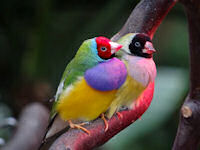
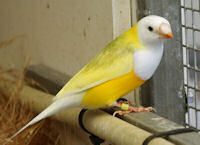
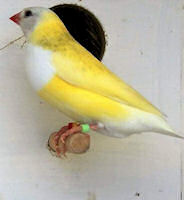
In monomorphic species, males and females are visually almost identical, making identification difficult. Dimorphic species are the opposite, where males and females can be distinguished visually.
There are many myths surrounding gender identification in birds. Some breeders believe sex can be determined using a magnet suspended over the bird like a pendulum. There is no scientific basis for this method, and it is no more accurate than tossing a coin.
Gouldian finches are dimorphic primarily because of colour tone. Males have brighter, stronger, and more vibrant colours than females. Body size, shape, and markings are unreliable indicators.
Reliable methods of sexing Gouldians include DNA testing, vent examination, observing singing behaviour, and colour comparison. Only males sing full songs; females make shorter, simpler sounds.
Even in white or albino Gouldian finches, males and females differ slightly in tone. These differences are subtle and easier to see when birds are placed side by side under good gender.
As experience increases, breeders often learn to identify sex by sound alone, as males often make sounds different to the hens. Hens make vocalisations that males often never produce, and patterns in calls can sometimes be recognised, though some species can still be difficult to identify gender by their calls.
The trick is getting to know the species better, it makes identifying males from the females a lot easier, even just by their calls.
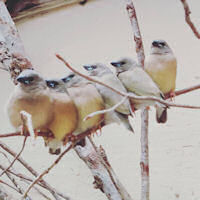
It is believed that parent birds may influence the gender of their chicks during incubation through heat regulation, potentially balancing male-to-female ratios. This theory has not been conclusively proven.
Anecdotally, flocks often appear to self-balance over time. Whether this is coincidence or biology remains uncertain.
During breeding season, hens may perform light dances, chirping and hopping in place to encourage males to sing and respond. Tail positioning between partners often indicates mutual selection.
In general, across most bird species, males tend to display brighter or more vibrant colours than females.